
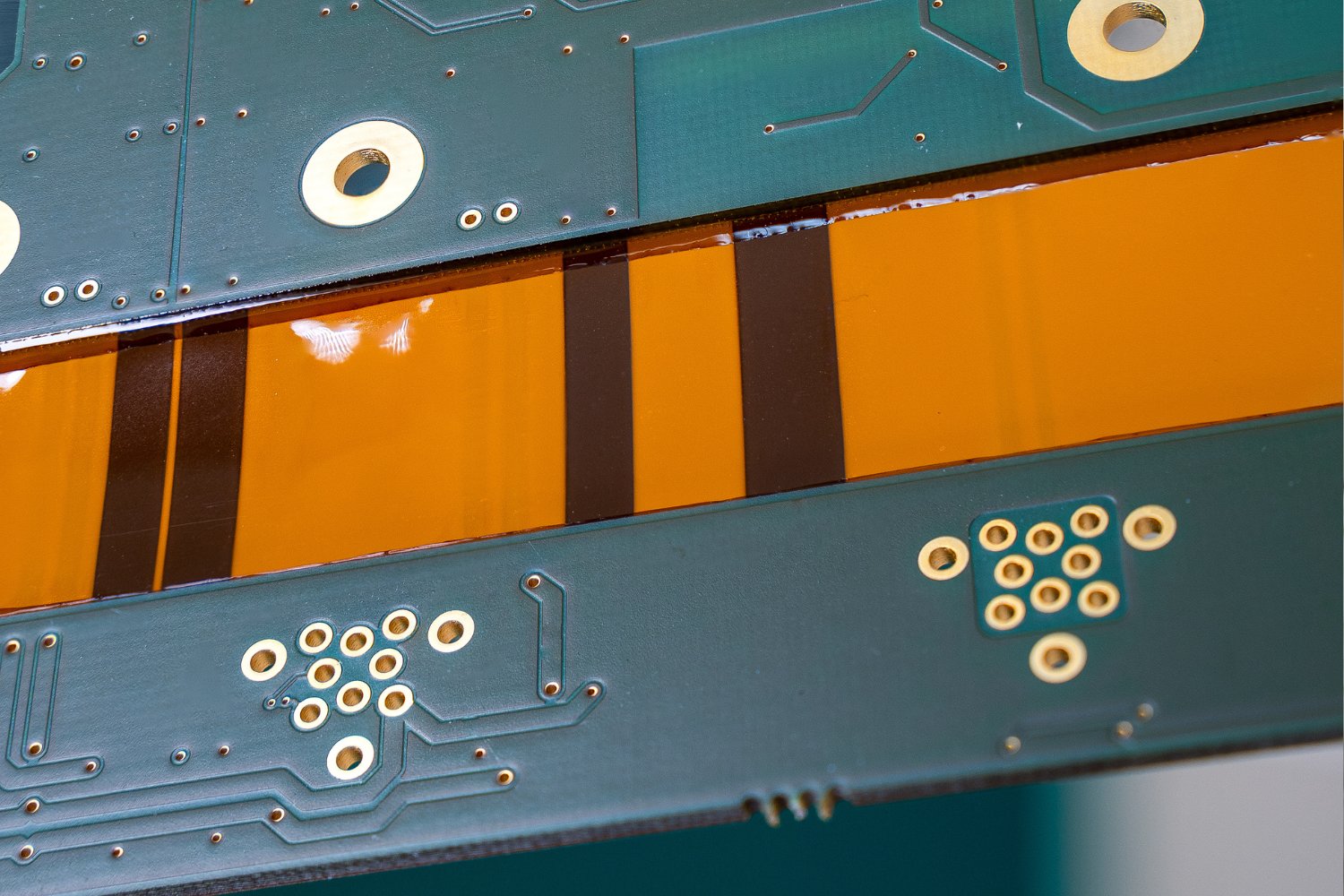
Additional mechanical safety for demanding applications
Rigid-flex printed circuit boards combine rigid and flexible sections into a single, continuous structure. This enables compact 3D assemblies, reduces the number of connectors, and creates reliable electrical connections in tight spaces.
The transitions between rigid and flexible areas are particularly challenging. This is where different material thicknesses, stiffnesses, and mechanical loads come into play. It is precisely at this point that a Edge Sealing or it may be advisable to use an external mechanical stress relief device.
For safety-critical applications—such as in aerospace, defense, medical technology, or high-performance industrial electronics—this supplementary technology can help provide targeted protection for sensitive rigid-flex transitions.
What is edge sealing for rigid-flex printed circuit boards?
In edge sealing, a suitable filling system is precisely applied to the transition area between the rigid and flexible sections of the printed circuit board. The material forms a defined application trail and can relieve mechanical stress at the transition.
The goal is to reduce local stress peaks, further stabilize the transition, and increase the circuit board's resilience to stresses caused by assembly, handling, or use.
Important to note: Edge sealing is not a standard procedure for every rigid-flex printed circuit board. It is evaluated on a project-by-project basis and implemented depending on the design, geometry, operating conditions, and customer requirements.
FAQ: Edge Sealing for Rigid-Flex PCBs
At the rigid-flex transition, the rigid section of the printed circuit board ends and the flexible section begins. At this point, the mechanical stiffness of the assembly changes significantly. Depending on the design, difference in thickness, bend radius, and installation conditions, increased mechanical stresses may occur at this location.
These stresses can be exacerbated, for example, by assembly, handling, vibration, shock, or thermal cycling. For this reason, the transition area should be examined with particular care as early as the design phase.
Sealing the edges can be particularly useful when the rigid-flex junction is subjected to higher mechanical stress or when the assembly is used in a safety-critical application.
Typical examples include:
- High standards for reliability and service life
- Applications in aerospace, defense, or medical technology
- Vibrations or shock loads
- complex assembly or handling processes
- Asymmetric rigid-flex assemblies
- larger differences in thickness between the rigid and flexible regions
- sensitive transition areas with limited installation space
The decision should always be based on the specific PCB design.
Edge sealing acts as an additional mechanical relief in the transition zone. It can help absorb the sudden change in stiffness between the rigid and flexible sections and distribute mechanical loads more evenly.
However, it does not replace a rigid-flex design optimized for manufacturing. The bend radius, layer stackup, trace routing, material selection, and installation space must still be properly designed. Edge sealing is a supplementary protective measure for particularly sensitive areas.
In safety-critical applications, it is not just the electrical functionality of the printed circuit board that matters. What is crucial is the interplay between design, materials, manufacturing, testing, and long-term reliability.
Edge sealing can serve as an additional component here to make mechanically sensitive areas more robust. It can help ensure the overall design’s reliability, particularly in applications with high durability requirements, limited installation space, or mechanical stress.
Typical applications include:
- Aerospace
- Defense
- Medical technology
- Transportation
- Sensors
- Industrial electronics with high safety requirements
Suitable filling systems are used for the application. The choice of material is project-specific and depends, among other things, on the geometry, PCB design, mechanical stress, and processing requirements.
Examples of possible materials include:
- LOCTITE Ablestik 45 Clear
- Scotch-Weld 2216 B/A
What matters is not only the material itself, but also its controlled and reproducible application within the intended area.
For the edge sealant to function properly, it must be applied cleanly, uniformly, and without any gaps. The area to be coated is defined according to the drawing specifications.
Among other things, the following should be avoided:
- Air bubbles
- Interruptions in the material
- Spills outside the application path
- Accumulations of material in the outlet area
- Contamination from oils, greases, or silicones
- mechanical damage
- Delamination or visible defects
Reproducible process quality is crucial, especially for safety-critical applications.
Ideally, edge sealing should be discussed during the design and construction phases. This allows for early consideration of application areas, space requirements, bend radii, and drawing specifications.
The sooner these issues are clarified, the easier it will be to balance design, manufacturability, quality, and cost.
Edge sealing is part of the overall design
Edge sealing should not be viewed in isolation. It is part of an overall technical concept consisting of:
- Layer structure with rigid and flexible sections
- Selection of Materials
- Bending Radius and Bending Direction
- Transition Geometry
- Conductor Path Guidance in the Flex Area
- mechanical stress in the end device
- UL and Documentation Requirements
- Testing and Release Strategy
Only the combination of these factors determines whether edge sealing is advisable and how it should be carried out.
Conclusion: Targeted protection for demanding rigid-flex applications
Edge sealing for rigid-flex printed circuit boards is not a one-size-fits-all solution. However, in safety-critical or mechanically demanding applications, it can be a useful additional protective measure.
It helps relieve mechanical stress on sensitive rigid-flex transitions and increase the robustness of the assembly—provided it is planned early on and implemented in a manner consistent with the PCB design.
We can assist you in evaluating the appropriate rigid-flex assembly, selecting materials, and determining whether additional edge sealing is advisable for your specific application.
Are you developing a rigid-flex printed circuit board for safety-critical applications?
Talk to our experts early on. Together, we’ll determine which rigid-flex assembly and material qualification are best suited for your application, and whether additional edge sealing is necessary.

